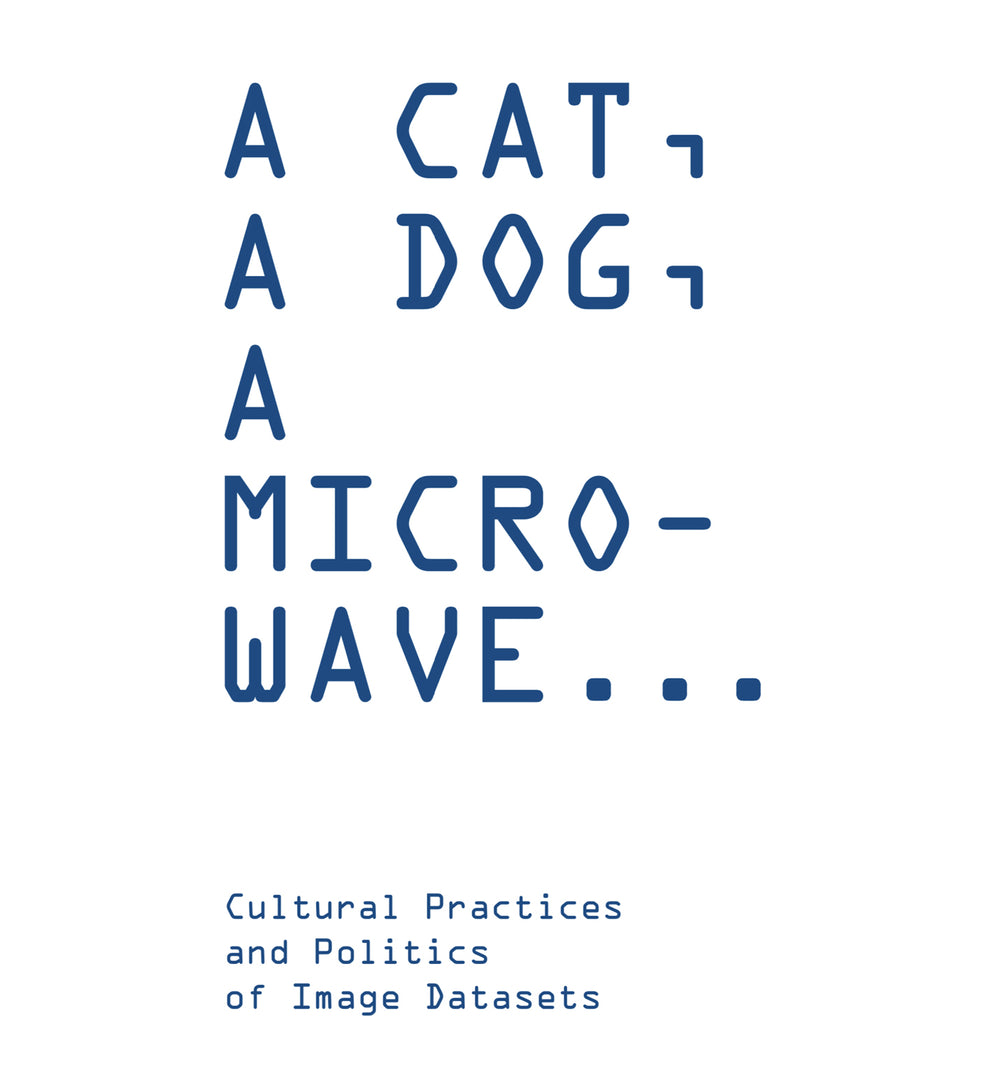
Zoyander Street reviewed A Cat, A Dog, A Micro-wave by Nicolas Malevé
Materially grounded and politically engaged
4 stars
This book has sat alongside Artifically Intelligent on my TBR pile for so long that I assumed I got them both from the same place. I didn't - there's five years between them in fact - but they do share a lot in common. The are both small volumes with minimalistic white covers, though this book is more sensibly printed as majority black and white pages with a few colour plates at the back; they both arose from curatorial projects that included exhibitions in London, in this case the 2023 Data/Set/Match show at Photographers' Gallery; and they are both anthologies of writing from a selection of contributors, many of whom had artworks included in the exhibition. Both include a contribution by Kate Crawford all the way at the back, though in this instance Crawford's interlocutor gets the author credit.
The editors of both books employ similar strategies when establishing …
This book has sat alongside Artifically Intelligent on my TBR pile for so long that I assumed I got them both from the same place. I didn't - there's five years between them in fact - but they do share a lot in common. The are both small volumes with minimalistic white covers, though this book is more sensibly printed as majority black and white pages with a few colour plates at the back; they both arose from curatorial projects that included exhibitions in London, in this case the 2023 Data/Set/Match show at Photographers' Gallery; and they are both anthologies of writing from a selection of contributors, many of whom had artworks included in the exhibition. Both include a contribution by Kate Crawford all the way at the back, though in this instance Crawford's interlocutor gets the author credit.
The editors of both books employ similar strategies when establishing the purpose of their projects and the relevane of "the museum", particularly museums focused on art and design, interacting with profit-driven technoscience fields. In this case, Nicholas Maleve states towards the conclusion of the book, "Data/Set/Match has highlighted the importance of opening computer vision to other forms of knowledge production [aside from technoscience] that involve artists, activists, and the public of cultural institutions. At this juncture, it is worth reflecting on the potential for questioning and engaging with machine vision in the specific context of a photographic institution." The museum is framed as a pluralistic site of dialogue, a place to ask questions, and of course, to do that sacred duty of everyone who wants to get funding for arts and culture - to "engage".
So it's a pleasant surprise to find this book packed with genuinely critical responses and grounded in the material conditions of the technological apparatus that its contributors examine. This is well supported by the fundamental focus of the project: datasets are a concrete object of study, in contrast to "artificial intelligence" a deliberate obfuscation that manipulates our tendency to anthropomorphise in order to redirect attention to bland theoretical questions about the nature of cognition. As contributors explore in a variety of ways, a dataset has a provenance, it is built on human labour, and it has a material existence in the world that is contingent on political and economic circumstances.
Another surprise is that, apart from Kate Crawford's delegated contribution, there is no overlap between the two projects' cohorts. In some ways, that's a shame: I would have liked to see Caroline Sinders's work in dialogue with the other projects discussed here, and I'm curious to see how speculative fabulations such as Ben Neal's A Robot In My Mind might have opened things up. But I feel more that the other project was far weaker for not including some of the outstanding thinkers seen in this one. I think Everest Pipkin is probably one of the most imaginative yet grounded artist-researchers in critical technoscience studies, and their chapter is a great example, connecting artistic work that manipulates an image dataset with the sub-minimal-wage work of labelling and reviewing. Alan F. Blackwell's chapter is also stunning, and exemplifies an uncompromising yet collegiate approach to critique that one would hope every project of this kind aims toward.
In a way, it's bothersome to me that this book is so good. I'm supposed to be decluttering, but I have to keep this book for future reference, because it's likely to continue being useful as more and more of what was once good about the world gets swallowed up by the eldritch sinkhole at the intersection of art and technology. I had the two books side by side not just to read, but to use for collage materials, but this one is too insightful and layered to be detourned (undetournable?). My plans are ruined, but it's worth it.