
Jim Fulner reviewed Veeck—As In Wreck by Bill Veeck
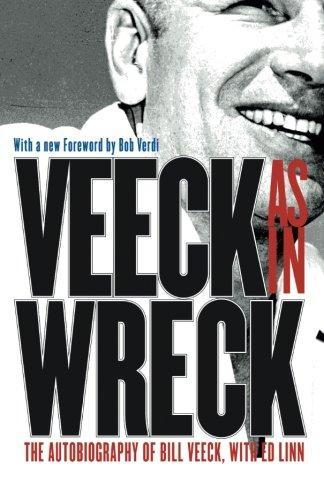
Bill Veeck was an inspired team builder, a consummate showman, and one of the greatest …
The yarn of a maverick.
5 stars
I really really liked Veeck as in Wreck. Autobiographies can sometimes be all over the place between what some people want to know and what others want you to know. Veeck tries to get a balance here, for example by making chapter 1 not about the beginning of his life, but of the story he knows everyone wants to hear, how he got a midget to bat for the St. Louis Browns.
He moves on to tell the story of his life focusing on his adventures as an owner/operator of a number of major and minor league teams over the year. Professional sports has often been a hobby for many rich people, sometimes a tax write-off for the big boys. Bill was the son of a newspaper writer and arguably the last man not independently wealthy to own a major league baseball team, financed by a bunch of arguably shady loans.
As such Veeck HAD to make money at baseball or the whole thing would fall apart, bringing in tons of zany promotions from door prizes of a flock of chickens, a herd of cows, or giving one fan 1,000 cans of beer (always more impressive than giving 1 can of beer to 1,000 fans). He needed to learn what people wanted, so he had to talk to people. Giving 100s of speeches a year to Rotary Clubs, Odd Fellows and the like, never sitting in the luxury box but instead sitting in each section a half-inning at a time to talk to the fans.
It made me jealous of mid-20th century baseball fans. The idea of showing up to the ballpark wearing a dress gives you a free ticket and a free flower on ladies' day just can't be done in early 21st century.
So many things Veeck was promoting then as baseball needing to do, it is now doing, like interleague play, pitch clock, unrestricted draft and expansion. The one thing he said was inevitable that hasn't occurred, and I don't think will, is American universities becoming year-round institutions (they offer summer classes but that's not the same) and college baseball becoming the summer highlight of the NCAA growing to replace the minor leagues as the primary birthplace of major league stars.
His antiracism is surprising for a man of his time: firing whites wouldn't shake the hand of a new black player in Cleveland; not to mention his attempt at buying the Phillies—before Jackie Robinson broke the color barrier—with an intent to replace its players with a team of Negro League all-stars, stifled by the National League buying up the team while he was on the train to Philadelphia.
I didn't give it the full 5 stars because a bit of it is too hard to believe, not so much the antics and the negro league story some people think he made up, but remembering the exact dollar amounts for every contract he sold from the minor leagues? I don't see him keeping records to that degree nor having that kind of memory.
For whatever reason I felt like he WANTED to write more about his family but felt that the fans wanted to hear more about baseball. While in the end it mentions that he had had five kids the last details we got on them was his oldest son Mike, the only one I'm aware of who followed him into the baseball world, was playing in his play pen in their St. Louis stadium apartment so he could watch the game without crawling away.
Recommended for sports fans and may be of interest for business folks.